
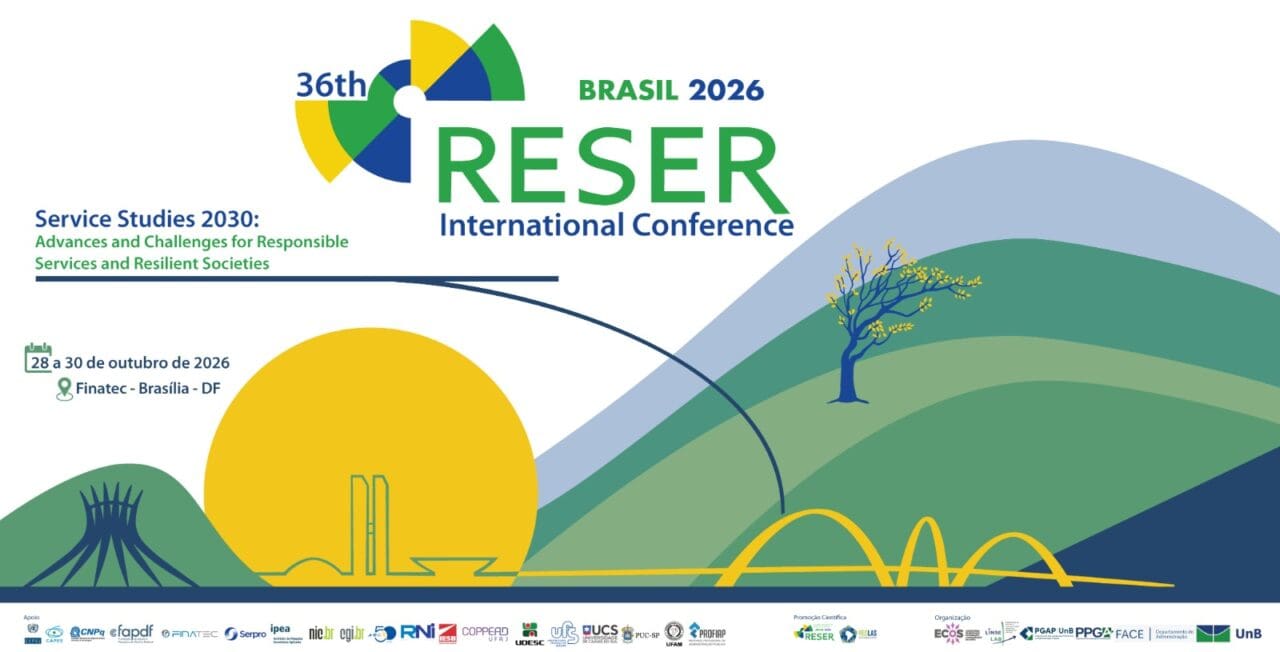
Service Studies 2030: Advances and Challenges for Responsible Services and Resilient Societies Brasília, Brazil | 28 to 30 October 2026

Conference at a glance
Hybrid Conference (in-person and online)
Organizing Committee e-mail: conference2026@reser.net
- Deadline for submitting the Short Papers: 22 May 2026, 23:59 (Brasília Time)
- Deadline to apply for the Peter Daniels Award on Original Ideas: 22 May 2026, 23:59 (Brasília Time)
- Notification of acceptance: 30 June 2026
- Deadline for submitting Full Papers from accepted Short Papers: 15 September 2026
- Deadline to apply for the RESER Young Researcher Award: 15 September 2026
- Deadline to apply for the RESER Best Paper Award: 15 September 2026
- Deadline for early registration: 18 September 2026
- Deadline for the registration: 16 October 2026
We are proud to announce the partner institutions supporting the 36th RESER International Conference. Their collaboration strengthens the academic excellence, international reach, and societal impact of our event:
Scientific Promoters:
- European Association for Research on Services (RESER)
- Latin American and Caribbean Network of researchers and policy makers in the field of Services (REDLAS)


Host Institution:
University of Brasília / Universidade de Brasília (UnB)
- Department of Administration (ADM/FACE/UnB)
- Graduate Program in Business Administration (PPGA/UnB)
- Professional Graduate Program in Public Administration (PGAP)
- Laboratory for Studies and Research on Innovation and Services (Linselab)




INSTITUTIONAL PARTNERS AND SUPPORTERS:
- Economic Commission for Latin America and the Caribbean (ECLAC)
- Brazilian Federal Agency for Support and Evaluation of Graduate Education (CAPES)
- National Council for Scientific and Technological Development (CNPq)
- Federal District Research Foundation (FAP/DF)
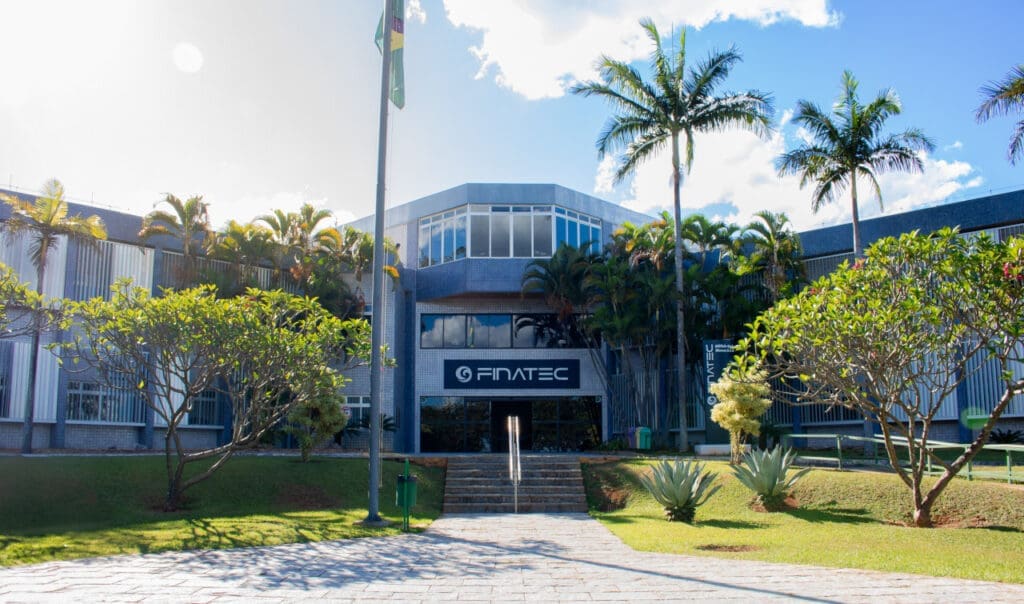
- Foundation for Scientific and Technological Enterprises (FINATEC)
- National Company for Intelligence in Digital Government and Information Technology (Serpro)
- Institute for Applied Economic Research (Ipea)
- Brazilian Network Information Center / Brazilian Internet Steering Committee
- Laboratory for Education, Information and Communication in Health (ECoS)
- Brazilian Academy of Management (ANPAD)
- Research Network on Innovation (RNI)
- University Center IESB
- Federal University of Rio de Janeiro (UFRJ/COPPEAD)
- Santa Catarina State University (UDESC)
- Federal University de Sergipe (UFS)
- University of Caxias do Sul (UCS)
- Pontifical Catholic University of São Paulo (PUC-SP)
- Federal University of Amazonas (UFAM)
- Postgraduate Program in Public Administration in the National Network (PROFIAP)



















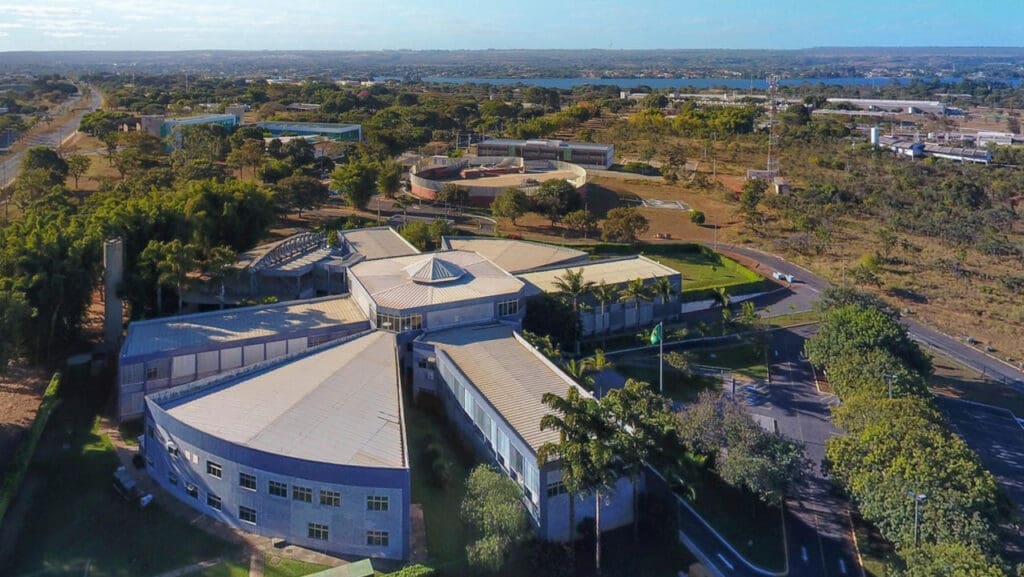
 University of Brasília – UnB
 University of Brasília – UnB
A transformative university, with the mission of producing, integrating, and disseminating knowledge, educating citizens committed to ethics, social responsibility, and sustainable development. This is the University of Brasília, whose trajectory is intertwined with the history of the nation’s capital. The construction of the campus emerged from the convergence of brilliant minds. The restless anthropologist Darcy Ribeiro defined the foundations of the institution. The educator Anísio Teixeira designed the pedagogical model. The architect Oscar Niemeyer transformed ideas into buildings. Born from the dream and work of educators such as Darcy Ribeiro and Anísio Teixeira, UnB has been, since its founding in 1962, one of Brazil’s leading academic references. The cultural diversity present across its four campuses is one of its defining characteristics. This plurality, combined with a constant pursuit of innovative solutions, drives the institution’s scientific output and daily life. UnB remains active in all fields of knowledge, open to the major demands of Brazil and the world. With its eyes set on the future and an appreciation for the path already traveled, the University establishes itself as an indispensable force for the development of a more ethical and democratic society. To learn more about the University of Brasília (UnB), please visit the website https://www.comparado.com.br/en/about
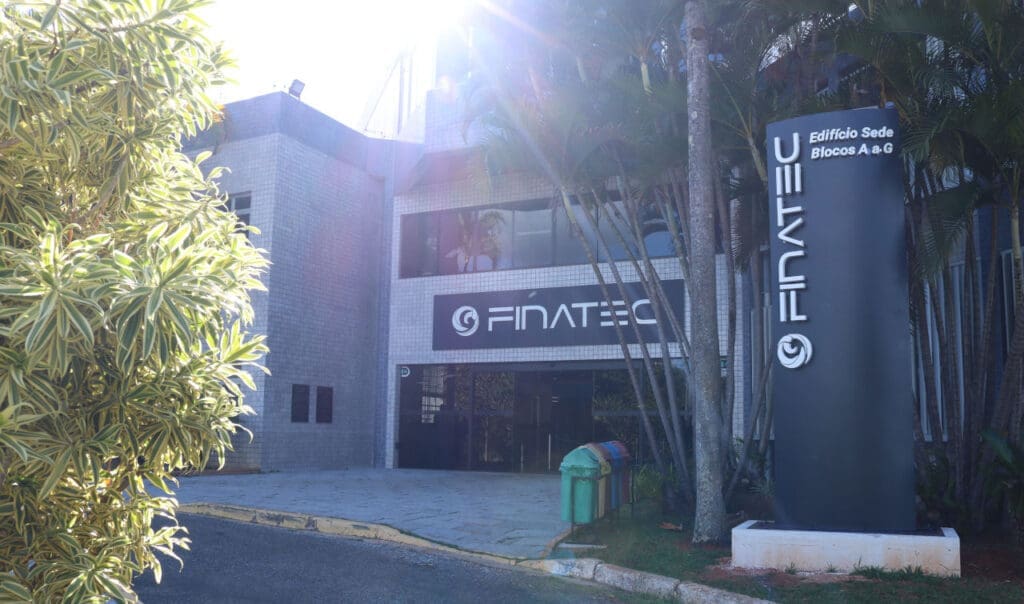
FINATEC – Fundação de Empreendimentos Científicos e Tecnológicos
Av. L3 Norte – Ed. Finatec
Campus Darcy Ribeiro
Asa Norte – Brasília-DF
Caixa Postal – 4365
CEP: 70910-903
Find here our hotel suggestions and parterships and take advantage of negociated discounts!
• SHN – Quadra 5 – Bloco B, Via N1 – Asa Norte, Brasília
Driving distance between the hotel and the event venue: approximately 5 to 7 km.
Driving time: about 10 to 15 minutes, depending on traffic.
By taxi or ride-hailing app: typically between R$ 15 and R$ 30.
10% discount on bookings for participants of the 36th RESER International Conference, based on the prevailing daily rate on our website.
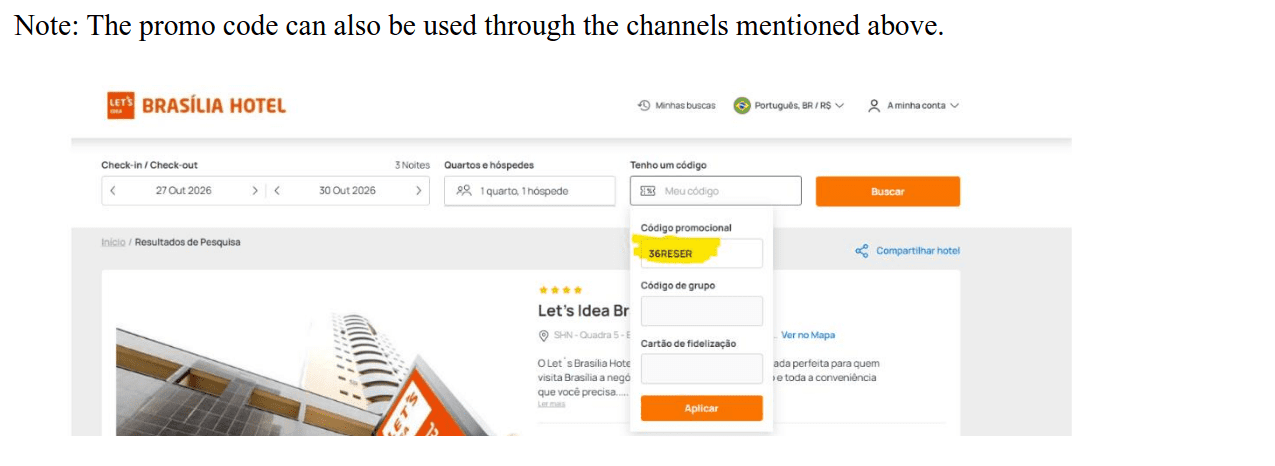
To make a reservation, please access the hotel’s website using the following link:
Enter the code 36RESER (in uppercase letters) in the “promotional code” field.
For any operational inquiries, please contact us by phone at +55 (61) 3424-2525 (also available on WhatsApp) or by email at reservas.bsb@letshotels.com.br / receitas.bsb@letshotels.com.br. Our service hours are Monday to Friday, from 8:00 a.m. to 6:00 p.m.

• Shn Qd 5 Bloco I, Asa Norte, Brasilia – DF, 70705912
Driving distance between the hotel and the event venue: approximately 5 to 7 km.
Driving time: about 10 to 15 minutes, depending on traffic.
By taxi or ride-hailing app: typically between R$ 15 and R$ 30.
20% discount on bookings for participants of the 36th RESER International Conference.
To make a reservation, please contact the Reservations Department:
Telephone: +55 61 3426-4000
E-mail: ana.fonseca@accor.com // bruno.goncalves@accor.com
Rate Code: “36thRESER“
-
The special rate is valid for stays of 3 nights or more, subject to availability, for accommodationsbetween October 26 and November 1, 2026.
-
Complimentary breakfast is included and served at the hotel’s restaurant.
-
ISS (Service Tax) is not included. Please add 5% to the daily room rate.

• Setor Hoteleiro Norte quadra 5, Bloco G, 70705913
Driving distance between the hotel and the event venue: approximately 5 to 7 km.
Driving time: about 10 to 15 minutes, depending on traffic.
By taxi or ride-hailing app: typically between R$ 15 and R$ 30.
20% discount on bookings for participants of the 36th RESER International Conference.
To make a reservation, please contact the Reservations Department:
Telephone: +55 61 3426-4000
E-mail: ana.fonseca@accor.com // bruno.goncalves@accor.com
Rate Code: “36thRESER“
- The special rate is valid for stays of 3 nights or more, subject to availability, for accommodations
between October 26 and November 1, 2026. - Complimentary breakfast is included and served at the hotel’s restaurant.
- ISS (Service Tax) is not included. Please add 5% to the daily room rate.
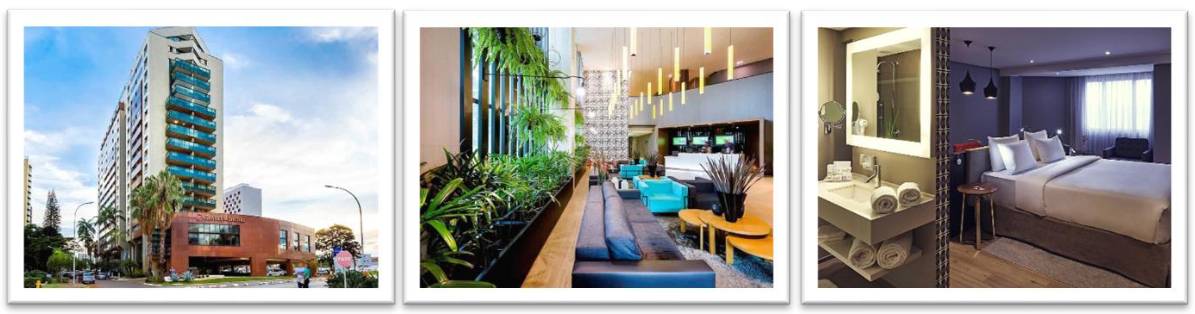
SHN Quadra 4, Bloco D, Asa Norte, Brasília – DF
Driving distance between the hotel and the event venue: approximately 5 to 7 km.
Driving time: about 10 to 15 minutes, depending on traffic.
By taxi or ride-hailing app: typically between R$ 15 and R$ 30.
Special Hotel Rate for participants of the 36th RESER International Conference:
- Superior Room: R$470.00 (single occupancy) and R$540.00 (double occupancy)
- Luxury Suite: R$540.00 (single occupancy) and R$610.00 (double occupancy)
Rates are valid only for reservations between October 26 and November 2, 2026.
Complimentary breakfast is served at the restaurant.
A 10% service charge and a 3% ISS (Service Tax) will be added to the daily room rates.
Comfort Suites Brasília
reservas.csb@ahi.com.br
Tel: +55 61 3424-6000
Fax: +55 61 3424-6001

Paper submission and registration : https://reser2026.confnow.eu/
Registration fees - In person or virtual participation
Early registration (until september, 18, 2026)
Regular fees*€120
Students€80
* Regular fees are intended for Full Professor, Associate Professor, Assistant Professor, Lecturer, and any other PostDoc positions. ** PhD Student fees apply to all students
After September 18 2026
Regular fees*€150
Students€100
The 36th RESER International Conference is pleased to partner with the following journals:
- European Review of Services Economics and Management
- Latin American Business Review
- International Journal of Knowledge-Based Development
- Brazilian Journal of Management Innovation
- Revista de Administração Contemporânea
- Revista Contabilidade, Gestão e Governança
- Revista de Administração Mackenzie – RAM
- Journal of Innovation Economics & Management (I-JIEM), specifically on the topic “Service Innovation in Society 5.0: Theories and Practices”
If your short paper has been accepted, you may submit the full-paper version of your article and apply for the Fast Track. Only papers submitted in full-paper format will be eligible to participate in the Fast Track. The full-paper template is available on the event website.
Would you like to know how the Fast Track works?
- The Author must submit the full-paper version of the article by September 15, 2026, through the ConfNow platform.
- The Author must indicate on the ConfNow platform which article(s) they wish to enter into the Fast Track and which journal(s) they prefer by September 15, 2026.
- The Fast Track Committee will select the best full papers, taking into consideration the number of articles each journal has agreed to receive, the authors’ preferences, and the Committee’s assessment of the article’s quality, in order to recommend the journal with the best fit for the paper.
- The Author must access the journal’s website and submit the manuscript by the deadline indicated by the Fast Track Committee of the 36th RESER International Conference.
- The Author must inform the Fast Track Committee of the 36th RESER International Conference that the article has been submitted.
- Articles submitted through the Fast Track will enter the journals’ priority review process.
Selection for the Fast Track does not imply acceptance for publication in the journal, nor does it guarantee acceptance at the initial editorial evaluation stage (desk review). Authors are responsible for monitoring the manuscript evaluation process and complying with the rules and procedures established by the journal.
The partner journals, in turn, ensure that articles selected for the Fast Track will be included in a priority review process. Depending on the journal, the articles may be published in special issues or included in special sections of regular issues, as will be announced in due course.
The 36th RESER International Conference Program Is Now Available!
Get ready for three exciting days of knowledge sharing, networking, and exchange of experiences! The program for the 36th RESER International Conference is now available, and we invite our entire community to explore the full versions in Portuguese and English and start planning their participation in the event.
Throughout the three days of the Conference, researchers, experts, professionals, and representatives from different institutions will come together to discuss relevant and urgent topics shaping the present and future of services. The program features discussions on digital services and data governance, energy services and the energy transition, public security, health, public services, artificial intelligence, diversity and inclusion in services, as well as many other topics reflecting the challenges and ongoing transformations in the field of services.
The Conference will also feature special moments designed to strengthen networks, create new opportunities for collaboration, and bring together researchers at different stages of their careers. On October 28, from 5:00 to 6:00 p.m., Special Session 1 – Connecting Researchers through RESER: Opportunities for Collaboration between Europe and Latin America will introduce a new RESER initiative aimed at expanding opportunities for collaboration between researchers in Europe and Latin America.
On October 30, the program includes other not-to-be-missed activities. From 10:30 a.m. to 12:00 p.m., the PhD Workshop will offer a dedicated space for doctoral students to discuss issues related to academic training, careers, and research projects. Later, from 3:30 to 4:00 p.m., Special Session 2 – Meet the Editors will provide another opportunity for dialogue and interaction between researchers and academic editors.
To celebrate the connections and achievements of this edition, on October 30, from 8:00 to 11:00 p.m., we will gather for the Cocktail Reception and Awards Ceremony, a special moment to celebrate and recognize the RESER community.
Explore the full program now in Portuguese and English, plan your schedule, and join us for the 36th RESER International Conference!
The Organizing Committee of the 36th RERER International Conference congratulates the authors of the accepted papers and thanks you for your contribution to the success of the event.
📅 PRESENTATION SCHEDULE
=> Download the full program (excel) <=
Authors will be able to check the scheduled date and time for their paper presentation through the Program_Parallel Sessions.
We recommend that all authors check their presentation time in advance and be present at the corresponding session venue at least 10 minutes before the scheduled start time.
To ensure the smooth organization and running of the sessions, we kindly ask authors to carefully observe the following guidelines:
1. Number of Presentations per Author
Each author may present only one paper during the conference.
2. Conference Registration
In order to present a paper, the presenting author must be duly registered for the conference.
3. Awards and Fast Track
Only papers that are actually presented during the conference will be eligible for the awards and the Fast Track opportunity offered by the event.
4. Presentation Template
The Organizing Committee has provided a presentation template, which can be accessed through this link
The use of the template is not mandatory. Authors may use their own presentation format, provided that they respect the allotted presentation time and the other conference guidelines.
5. Presentation Time
Each author will have between 10 and 15 minutes to present their paper. Authors are strongly encouraged to plan their presentations so as to strictly adhere to this time limit.
6. Discussion After the Presentation
Following each presentation, the session chair will allow approximately 5 to 10 minutes for discussion, questions, and comments regarding the presented paper.
7. Presentation Language
In principle, presentations should be delivered in English, given the international nature of the conference. This does not prevent authors from using another language to complement or clarify specific points of their presentation when necessary.
To assist participants during the sessions, the conference organizers will provide bilingual (English–Portuguese) volunteers who will be available to offer language support and facilitate communication during presentations and discussions.
Once again, we thank all authors for their participation and look forward to excellent presentations and discussions during the 36th RERER International Conference.
Organizing Committee
36th RERER International Conference
The call for papers is available for download :
Objectives
The 36th RESER International Conference aims to bring together academics, policymakers, public managers, entrepreneurs, and civil society representatives to: • Debate theoretical and empirical advances and challenges in service studies towards 2030; • Explore how services can mitigate global risks and strengthen social resilience; • Promote a responsible, inclusive, and sustainable vision of services; • Examine how services-led, digitally enabled trade and integration support inclusive development.
Thematic tracks
Submissions from various fields (economics, management, sociology, law, etc.) are welcome, provided they contribute to service studies. Each paper must fit into one of eight thematic tracks: Track 1 – Services as Catalysts for New Economic Paradigms It explores how services can prompt a rethinking of the foundations of the contemporary economy, fostering more ethical, collaborative and public value-oriented models. It also examines the governance dilemmas that arise within interdependent and multilateral systems, and the ways in which trust and transparency strengthen ecosystems of innovation and inclusion. Suggested themes: ethics of public decision-making; institutional trust, accountability, corruption and integrity; co-production; transparency; value creation; regulation, soft law, and legal services in collaborative economies; judicialisation of public policies and their impacts on service systems. Track 2 – Transitions, Public Policies, and Public Services It investigates how innovative ; public policies (at national, supranational, regional or local levels) can transform public services into strategic instruments of social and environmental resilience. It examines forms of intersectoral and multi-level cooperation capable of integrating economic, social, and ecological objectives, thereby enhancing the adaptive capacity of communities and territories in the face of global risks. Suggested themes: service ecosystems; collaborative networks; territories; citizen participation; climate adaptation; just energy transition; food security; migration, and territorial resilience policie; legal regulation of climate, energy, and digital transitions. Track 3 – Innovation, digital transformation and artificial intelligence in Services [in partnership with RNI-Research Network on Innovation] It examines how emerging technologies are transforming value creation and delivery in services. It discusses the balance between efficiency and ethical responsibility, as well as the impacts of digital transformation on work, learning and human relationships. Suggested themes: servitisation; digital transformation; artificial intelligence in services; generative AI; automation; algorithmic ethics; sustainable digital innovation; the impact of AI on work; data protection; data governance; misinformation; information security; ethical design and accountability in digital platforms; innovation in education, healthcare, and other fields; public innovations; ethics, accountability, and transparency in digital legal systems. Track 4 – Service Marketing and Consumer Behaviour It examines how service marketing and consumer behaviour shape value creation within interactions among users, organisations and service ecosystems. It investigates how perceptions, emotions, trust, perceived quality, engagement and multichannel experiences influence consumer decisions, journeys and well-being across physical, digital and hybrid contexts. It also addresses trends such as data-driven personalisation, digital platforms and reputation, sustainable consumption and the ethical design of experiences, contributing to a more responsible, innovative and user-centred understanding within service studies. Suggested themes: digital marketing; purchase decision-making; service personalisation; responsible marketing; social marketing, data governance, digital trust, exploitation of vulnerable consumers, information security, ethical design and accountability in digital platforms; responsible marketing of legal services. Track 5 – Sustainable, Circular, and Regenerative Services It explores how services can drive the ecological transition by combining technological innovation, environmental responsibility, and social value. It analyses models of sustainable servitisation and regenerative design. It also discusses strategies for decarbonisation, the bioeconomy, and urban regeneration, positioning services as key agents of systemic sustainability and territorial cohesion. Suggested themes: ecological transition, circular economy, sustainable servitisation, regenerative design, service decarbonisation, bioeconomy, sustainability indicators in services; sustainable contracts and regenerative legal models. Track 6 – Service Ecosystems, Collaborative Networks, Territories and Citizen Participation This track explores how actors within the Social and Solidarity Economy (SSE), social enterprises and cooperatives foster inclusive growth and innovation oriented towards social impact. It analyses mechanisms of co-production and citizen engagement capable of strengthening community ties and generating new forms of shared value. Suggested themes: collaborative economy; social and solidarity economy; energy cooperatives; social entrepreneurship; emancipatory entrepreneurship; social innovation and value co-creation; territorial service ecosystems; community-based regulation logics; collaborative conflict resolution. Track 7 – Culture, Arts and Well-being in Services It analyses the role of educational, cultural and health services in building social and territorial cohesion, human capital and quality of life. It emphasises innovative ractices that integrate technology, care and citizen participation, thereby strengthening well-being and human development in a broad sense. Suggested themes: creative economy; digital health; communication and education in public health; public well-being policies; organisational well-being policies; intergenerational learning; well-being and urban development; justiça restaurativa. Track 8 – Inclusion, Gender, Race and Diversity in Services It analyses the role of educational, cultural and health services in building social cohesion, human capital and quality of life. It emphasises innovative practices that integrate technology, care and citizen participation, thereby strengthening well-being and human development in a broad sense. Suggested themes: structural racism; intersectional feminism; accessibility of vulnerable groups to public and private services; diversity policies within organisations; access to justice and structural inequalities. Track 9 – International Trade, Regional Integration and Development-Oriented Services This track explores how international trade and regional integration shape development trajectories, with particular attention to the strategic role of services, especially digitally delivered services, in global and regional value chains. It examines how trade policies, productive integration, logistics, digital trade, and regulatory frameworks influence structural transformation, export diversification, productivity, and sustainable development in developing and emerging economies. The track also addresses the institutional and governance dimensions of integration processes, including asymmetries across countries and firms, regional cooperation mechanisms, and the design of inclusive trade and services-export promotion strategies. Suggested themes: international trade in services and digitally delivered services; regional economic integration; global and regional value chains and servicification; trade and productive development policies; logistics and infrastructure services; digital trade and e-commerce; trade facilitation and regulatory cooperation; services export promotion; South–South and South–North cooperation; inequality, employment, and sustainable development; and institutional frameworks for regional integration.
Paper submission
Short papers must be submitted in the format outlined below. They will be subjected to blind peer review by members of the event’s scientific committee. • Short paper: Empirical or theoretical studies, 5-6 pages (~2,000 words), excluding references. Authors must submit their work using the Short Paper Template (Download HERE). Authors of accepted short papers are strongly encouraged to submit the full version of the paper and compete for the awards. Only authors whose short papers have been accepted will be able to submit full papers. Full papers must be submitted in the format outlined below. • Full paper: Empirical or theoretical studies, 10-12 pages (~5,000 words), excluding references. Authors must submit their work using the Full Paper Template (coming soon). Only unpublished papers that have not been presented or accepted elsewhere will be considered. Submissions derived from prior research must demonstrate original and new contributions. Papers must be submitted in English and presented in English during the conference. Master’s students are eligible to submit papers only if the submission is co-authored with a doctoral student or a PhD holder.
Awards
At the 36th RESER International Conference, three awards will be granted: • Peter Daniels Award on Original Ideas: recognizes outstanding academic work that demonstrates exceptional originality, creativity, and innovative thinking. The award honors Peter Daniels, a pioneering scholar in the field of services and economic geography. He taught for 33 years at the School of Geography, Earth and environmental Sciences at the University of Birmingham and is widely known for his influential books and research on the role of services in economic development, innovation, and organizational transformation. A founding member of RESER, he served as its President from 1995 to 2001 and received the RESER Lifetime Achievement Award in 2009 at the 19th RESER Conference in Budapest. • RESER Young Researcher Award (Reser Founder’s Award): recognises academic excellence among doctoral students, promoting the dissemination of their research within the RESER community and international scientific networks. • RESER Best Paper Award: recognises excellence in research with solid theoretical foundations, rigorous methodology, and relevant contributions to service research, professional practice, and society. To be eligible for the Peter Daniels Prize for Original Ideas, authors must submit a short paper. To be eligible for the RESER Young Researcher Award (RESER Founder’s Award), authors must submit a full paper and must be enrolled as doctoral students or have submitted their doctoral thesis in 2025 or 2026. To be eligible for the RESER Best Paper Award, authors must submit a full paper. In the case of the RESER Prize for Young Researchers (RESER Founder’s Prize), RESER will award €1,000 to the first-place winner and €500 to the second-place winner. This prize aims to encourage doctoral students in the development of their research. The other awards consist of an honorary distinction, with special recognition of academic excellence given to the first-place paper, and without a monetary prize. Each paper submitted may be considered for only one award. Additional rules for the awards are available on the RESER website.
Organising Committee
- Josivania Silva Farias, University of Brasília (Coordinator)
- Luciana Oliveira Militão, University of Lille (Co-coordinator)
- Renato Calhau Codá, University of Brasília (Co-coordinator)
- Aldery Silveira Junior, University of Brasília
- Antonio Isidro da Silva Filho, University of Brasília
- Bruno Eduardo Freitas Honorato, University of Brasília
- Eda Castro Lucas de Souza, University Center of the Institute of Higher Education of Brasília (IESB)
- Eduardo Raupp de Vargas, COPPEAD/Federal University of Rio de Janeiro
- Karim Marini Thome, University of Brasília
- Kleverton Melo de Carvalho, Federal University of Sergipe (UFS)
- Micheline Gaia Hoffmann, University of the State of Santa Catarina (UDESC)
- Abner Santos Belém, University of Brasília
- Daniel Alves Oliveira, University of Brasília
- Elainy Cristina da Silva Coelho, Federal Institute of Tocantins
- Maria Luiza Campos Gaiger, University of Brasília
- Marina Figueiredo Moreira, University of Brasília
- Nágila Rodrigues Paiva, University of Brasília
- Patrícia Gomes Rêgo de Almeida, University of Brasília
- Pedro Henrique Pires Silva, University of Brasília
- Sílvia Régia Vieira de Freitas Filha, University of Brasília
Scientific committee
Meet the Scientific Committee of the 36th RESER International Conference, composed of distinguished researchers from institutions in diverse countries:
- Abimael Magno do Ouro Filho, Universidade Federal de Sergipe, Brasil
- Alex Eckert, Universidade de Caxias do Sul, Brasil
- Ana Cristina Fachinelli Bertolini, Universidade de Caxias do Sul, Brasil
- Andrea Juliet Celis León, Universidad Militar Nueva Granada, Colômbia
- Antonio Isidro da Silva Filho, Universidade de Brasília, Brasil
- Bento Alves da Costa Filho, Universidade de Brasília, Brasil
- Bruno Alencar Pereira, Universidade Flinders, Austrália
- Bruno Setton Gonçalves, Universidade Federal de Sergipe, Brasil
- Carlos Alberto Dihel, Universidade de Caxias do Sul, Brasil
- Caroline Cordova, IBMEC, Brasil
- Cleiton Rodrigues de Vasconcelos, Universidade Federal de Sergipe, Brasil
- Cintia Paese Giacomello, Universidade de Caxias do Sul, Brasil
- Céline Merlin-Brogniart, Université de Lille, França
- Daisy Bertrand, Université Aix-Marseille, França
- Eda Castro Lucas de Souza, Centro Universitário IESB, Brasil
- Eduardo Raupp de Vargas, Universidade Federal do Rio de Janeiro – COPPEAD, Brasil
- Elainy Cristina da Silva Coelho, Instituto Federal do Tocantins, Brasil
- Emerson Cleister Lima Muniz, Universidade Federal de Sergipe, Brasil
- Emmanuel Fragnière, HES-SO Valais-Wallis, Suíça
- Estibaliz Hernandez, Mondragon Unibertsitatea, Espanha
- Faïz Gallouj, Université de Lille, França
- Faridah Djellal, Université de Lille, França
- Francisco Antonio Coelho Jr, Universidade de Brasília, Brasil
- Gilmara Aparecida de Freitas Dias, Universidade Estadual de Montes Claros, Brasil
- Glessia Silva de Lima, Universidade Federal de Sergipe, Brasil
- Ida Gremyr, Chalmers University of Technology, Suécia
- Jamile Sabatini Marques, Universidade de Caxias do Sul, Brasil
- Janaina Macke, Universidade de Caxias do Sul, Brasil
- Janine Flith de Medeiros, Universidade de Caxias do Sul, Brasil
- Jaqueline Corá, Universidade de Caxias do Sul, Brasil
- Jean Philippe, Université Aix-Marseille, França
- Johan Mulder, University of Groningen, Países Baixos
- Jon Sundbo, Roskilde University, Dinamarca
- José Ricardo de Santana, Universidade Federal de Sergipe, Brasil
- Josivania Silva Farias, Universidade de Brasília, Brasil
- Kirsi-Maria Hyytinen, VTT Technical Research Centre of Finland, Finlândia
- Kleverton Melho de Carvalho, Universidade Federal de Sergipe, Brasil
- Lars Fuglsang, Roskilde University, Dinamarca
- Liziane Paixão Silva Oliveira, UniCEUB, Brasil
- Luciana Oliveira Militão, Université de Lille, França
- Luna Leoni, Università degli Studi di Roma Tor Vergata, Itália
- Marcelo Benetti Correa da Silva, Universidade de Caxias do Sul, Brasil
- Marianne Abramovici, Université Gustave Eiffel, França
- Maria Conceição Melo Silva Luft, Universidade Federal de Sergipe, Brasil
- Marja Toivonen-Noro, University of Helsinki, Finlândia
- Mateus de Sousa Martins, Universidade de Brasília, Brasil
- Mateus Panizzon, Universidade de Caxias do Sul, Brasil
- Márcia Rossi, Universidade Federal do Rio de Janeiro – COPPEAD, Brasil
- Marie-Christine Iongé Monnoyer, Institut Catholique de Toulouse, França
- Michel Bregolin, Universidade de Caxias do Sul, Brasil
- Micheline Gaia Hoffmann, Universidade do Estado de Santa Catarina, Brasil
- Patrícia Guarnieri, Universidade de Brasília, Brasil
- Patrícia Gomes Rêgo de Almeida, Universidade de Brasília, Brasil
- Pedro Costa, Universidade de Lisboa, Portugal
- Peter Martin Smith, Université de Lille, França
- Rafael de Lucena Perini, Universidade de Caxias do Sul, Brasil
- Raquel Botelho, Universidade Presbiteriana Mackenzie / Université de Lille, Brasil / França
- Raul Yukihiro Matsushita, Universidade de Brasília, Brasil
- Renato Calhau Codá, Universidade de Brasília, Brasil
- Suylan Midlej, Universidade de Brasília, Brasil
- Tiziana Russo Spena, Università degli Studi di Napoli Federico II, Itália
- Tomás de Aquino Guimarães, Universidade de Brasília, Brasil
- Vera Lúcia Steiner, Universidade de Caxias do Sul, Brasil
- Veronika Belousova, Higher School of Economics (HSE), Rússia
Registration fees - In person or virtual participation
Early registration (until september, 18, 2026)
Regular fees*€120
Students€80
After September 18 2026
Regular fees*€150
Students€100
* Regular fees are intended for Full Professor, Associate Professor, Assistant Professor, Lecturer, and any other PostDoc positions. ** PhD Student fees are exclusively intended for Doctoral Students currently enrolled in a PhD Program.
News about the conference
News and papers
Dead line for abstract submission 5 May 2026 !!
You are interested in the theme "Service Studies 2030: Advances and Challenges for Responsible Services and Resilient Societies" which is the subject of the next Reser annual conference. It will take place in Brasília, Brazil, from 28 to 30 October 2026 Please note that the deadline for submitting paper proposals is...

In 2026, Reser will go with you in Brazil
It is always a pleasure to wish all members of a community a wonderful year, full of discoveries, encounters, and, of course, successes. In 2026, our annual conference, which usually focuses on its European origins, will cross the Atlantic for the first time. Let us welcome this new development and thank...

Be carefull to the early bird RESER conference registration!
Our annual convention is just around the corner! All researchers who have proposed a communication project now have the answer from the selection committee! It's now time to register, as early bird conference registration closes on September 12 ... Just visit https://reser2025.confnow.eu We look forward to seeing you in Rome on October 30.